What is conversational ivr? Conversational IVR is a modern type of interactive voice response that lets callers speak naturally instead of pressing buttons. Using artificial intelligence and speech recognition, conversational IVR can understand what people say, figure out their intent, and route or resolve their requests in real time.
Instead of forcing callers through long, confusing menus, conversational IVR acts like a friendly virtual agent that asks, “How can I help you today?” and responds intelligently. This works well together with contact center AI for omnichannel support, and virtual agent assist for ai customer service provides extra guidance in real time.
Businesses today need smarter ways to help customers. Using advanced voice technology and automated routing improves service and reduces wait times. Many companies are exploring AI computing platforms for faster customer service to manage these systems efficiently. This lets them handle calls quickly and give accurate answers.
Some organizations also use supercomputers for customer service analytics to understand large amounts of customer interactions. These insights help improve service quality. When combined with conversational IVR, it creates an experience that is automated but still feels personal.
Marketing is also important. Using customer-focused marketing tips helps businesses communicate better. Pairing these strategies with conversational IVR allows companies to give personalized support that makes customers feel valued.
Digital marketing solutions for better engagement help share these services with customers. From automated notifications to messages across different channels, AI and conversational IVR work together to create a smooth customer journey.
Financial organizations benefit too. Using top resources for AI in banking and finance allows banks and investment firms to provide quick answers to common questions. Conversational IVR gives smart self-service options that save time and improve accuracy.
Overall, conversational IVR combines natural speech understanding, smart routing, and easy integration with other systems. As more companies adopt AI and omnichannel support, the future of customer service will rely on these smart voice solutions, giving customers a helpful, personal, and efficient experience.
Top 10 Contact Center Solutions for AI-Powered Customer Service
Understanding what is conversational IVR is crucial for businesses looking to improve customer experience. These contact center solutions use AI, advanced routing, and automation to streamline communication and boost efficiency. Here’s a list of the top solutions available today, starting with Bright Pattern.
1. Bright Pattern: AI-Driven Call Center Solutions
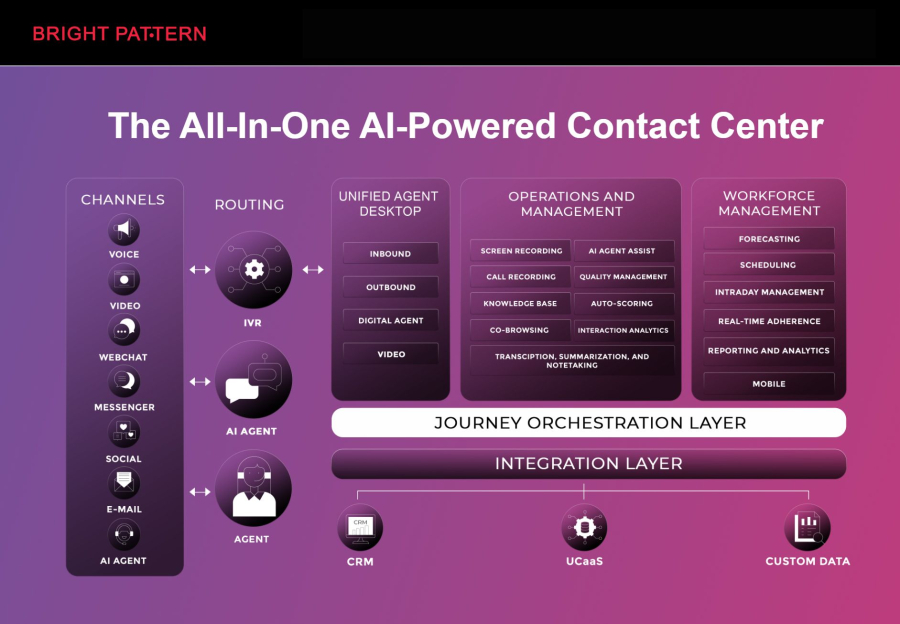
Bright Pattern leads the industry with a comprehensive AI-powered contact center platform that integrates conversational IVR, omnichannel support, and analytics. It enables businesses to deliver seamless customer experiences across voice, chat, email, and social media.
Key features of Bright Pattern:
- Conversational IVR for natural voice interactions
- AI-assisted routing to direct customers to the right agent
- Omnichannel support for consistent experiences across channels
- Analytics and reporting for data-driven decision making
- Virtual agent assist to improve first-contact resolution
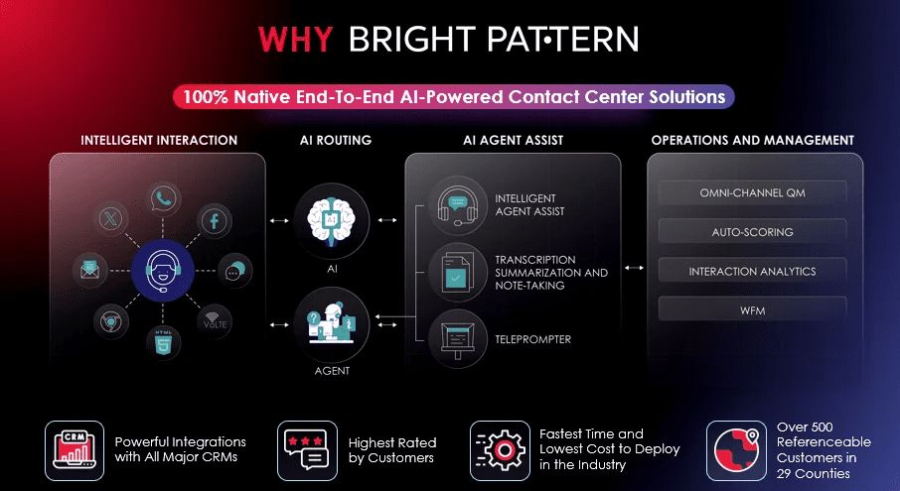
Bright Pattern is ideal for businesses seeking a scalable, flexible, and intelligent call center solution that supports both live agents and automated self-service. Companies can leverage AI to reduce call handling time, improve customer satisfaction, and manage high call volumes efficiently.
2. Genesys Cloud CX
Genesys Cloud CX offers AI-powered routing, workforce optimization, and omnichannel support. It’s designed for businesses looking to unify customer interactions and improve service quality.
3. Five9 Intelligent Cloud Contact Center
Five9 provides a cloud-based platform with AI-driven call routing, predictive dialing, and real-time reporting. Its virtual assistant capabilities complement conversational IVR for better self-service options.
4. NICE inContact CXone
CXone combines AI and analytics to optimize customer interactions across multiple channels. It also features automated workflows and intelligent routing to enhance efficiency.
5. Talkdesk CX Cloud
Talkdesk offers AI-driven workflows, speech analytics, and omnichannel contact handling. Its automation tools help agents resolve issues faster while maintaining high customer satisfaction.
6. 8x8 Contact Center
8x8 provides a cloud-based solution with integrated voice, video, chat, and email. Its AI features support natural language understanding and improve call resolution.
7. Avaya OneCloud CCaaS
Avaya’s solution emphasizes AI-driven customer engagement, offering virtual agent integration, advanced analytics, and scalable contact center operations.
8. RingCentral Contact Center
RingCentral uses AI and automation to enhance call handling, routing, and reporting. Its platform is designed to streamline operations for mid- to large-sized businesses.
9. Cisco Unified Contact Center Enterprise
Cisco’s solution provides AI-enhanced routing, omnichannel integration, and analytics. It supports complex enterprise workflows and large-scale call centers.
10. Aspect Unified IP
Aspect offers workforce optimization, AI routing, and self-service options. Its conversational IVR and automation features help improve both agent efficiency and customer satisfaction.
Conversational IVR in Simple Terms
Traditional IVR systems rely ontouch-tone inputor a narrow set of spoken phrases like“Say ‘billing’ for billing.”In contrast, conversational IVR uses natural language understanding (NLU) to recognize open-ended speech such as:
- “I want to check the status of my order.”
- “I need to update the card on my account.”
- “I’m moving and want to transfer my service.”
The system then determines the caller’s intent and responds or routes them to the right destination without forcing them through multiple menu layers.
In other words, conversational IVR transforms the phone tree into a natural, two-way conversation that feels faster, easier, and more human.
How Conversational IVR Works (Step by Step)
Behind the scenes, conversational IVR combines several technologies to create a smooth experience. The typical flow looks like this:
- Greeting and prompt– The IVR greets the caller and invites them to speak freely, for example:“Welcome. In a few words, tell me what you’re calling about.”
- Speech recognition– Automatic speech recognition (ASR) converts the caller’s spoken words into text.
- Natural language understanding– NLU analyzes the text to identify the caller’s intent (what they want) and key details (such as account type, product name, or location).
- Decision and routing– A business rules engine or AI-driven dialog manager decides what to do next: answer a question, ask for clarification, access a backend system, or transfer to a live agent.
- Response generation– The system formulates a spoken reply, which may include personalized information such as account balance, order status, or appointment times.
- Text-to-speech– Text-to-speech (TTS) converts that reply into a natural-sounding voice response for the caller.
This loop continues as a natural conversation until the caller’s issue is resolved or escalated to an agent with full context.
Conversational IVR vs. Traditional IVR
To understand the impact of conversational IVR, it helps to compare it directly with traditional menu-based IVR systems.
Aspect | Traditional IVR | Conversational IVR |
Caller interaction | Keypad input and limited voice commands | Natural, open-ended speech |
Menu navigation | Fixed, linear menus; multiple layers | Direct routing based on expressed intent |
Flexibility | Rigid flows; hard to adapt to new use cases | Adaptable dialog; easier to add intents |
Customer effort | High; callers often repeat or backtrack | Low; callers describe needs in their own words |
Personalization | Limited; mostly account lookup | High; can tailor based on history and context |
Containment and automation | Often low; many calls reach agents | Higher; more issues resolved self-service |
Customer experience | Can be frustrating or outdated | Feels modern, intuitive, and human-like |
Key Benefits of Conversational IVR
Organizations adopt conversational IVR because it delivers tangible benefits for both customers and operations.
1. Faster, Easier Customer Experiences
- No more menu mazes– Callers skip long lists of options and simply state what they need.
- Reduced handle time– Intelligent routing and automation get callers to the right outcome more quickly.
- 24/7 availability– Customers get immediate assistance, even outside contact center hours.
2. Higher Self-Service Containment
- Automated resolution– Many routine tasks can be fully handled by conversational IVR, such as checking balances, resetting passwords, or confirming appointments.
- Lower transfer rates– Fewer calls need to be escalated to agents, especially for simple, high-volume inquiries.
- Scalable service– Systems handle large call spikes without compromising response times.
3. Reduced Operational Costs
- Fewer agent minutes– Automating repetitive calls frees agents to focus on complex, high-value interactions.
- More efficient staffing– Sharper demand forecasting and reduced peak pressure on live agents.
- Lower training burden– As routine questions move to self-service, new agents spend more time on meaningful problem solving.
4. Better Agent Experiences
- Smarter call routing– Agents receive calls that match their skills and expertise.
- Context-rich transfers– When calls do reach agents, they come with transcripts, intents, and history, so customers do not need to repeat themselves.
- Higher job satisfaction– Less time on repetitive tasks, more time building relationships and resolving complex issues.
5. Actionable Insights from Voice Data
- Intent analytics– Understand why people are calling and which topics drive the most demand.
- Voice of the customer– Analyze real conversations to identify friction points, product issues, or unmet needs.
- Continuous improvement– Use call data to refine scripts, automate new intents, and optimize the end-to-end journey.
Common Use Cases for Conversational IVR
Conversational IVR is versatile and can be tailored to different industries and business models. Here are some popular use cases.
Banking and Financial Services
- Check account balances and recent transactions.
- Activate or freeze cards.
- Make payments and transfer funds.
- Get information on loans, interest rates, or branch locations.
Retail and E-commerce
- Track order status and delivery updates.
- Handle returns, exchanges, or refunds.
- Answer product or availability questions.
- Support loyalty program and account inquiries.
Telecommunications and Utilities
- Pay bills or set up automatic payments.
- Report outages or service issues.
- Change plans, add services, or update addresses.
- Provide proactive outage and restoration notifications.
Healthcare and Insurance
- Schedule, confirm, or cancel appointments.
- Check coverage, copays, and claims status.
- Answer plan or network questions.
- Provide pre-visit instructions and post-visit follow-ups.
Travel and Hospitality
- Check flight or booking status.
- Change or cancel reservations.
- Handle loyalty program questions.
- Provide check-in details, directions, and local information.
Key Capabilities of a Strong Conversational IVR
Not all conversational IVR systems are equal. The most effective solutions typically include these capabilities.
Advanced Speech Recognition
- High accuracyeven in noisy environments.
- Support for different accentsand speaking styles.
- Continuous speech handlingrather than single keywords.
Robust Natural Language Understanding
- Intent detectionto understand the purpose of the call.
- Entity extractionto capture details like dates, amounts, or product names.
- Context awarenessto follow multi-step conversations without losing track.
Integration with Backend Systems
- CRM and account systemsto personalize responses and authenticate callers.
- Billing, order management, and ticketing platformsfor real-time updates.
- Contact center infrastructuresuch as automatic call distributors and workforce management tools.
Flexible Dialog Management
- Configurable conversational flowsthat business users can update without deep coding.
- Fallback strategiesfor unclear requests, such as offering options or transferring quickly to an agent.
- Multi-turn supportto handle complex, step-by-step tasks.
Analytics and Optimization Tools
- Real-time dashboardsshowing call volumes, intents, and containment rates.
- Transcription and searchacross calls for deeper analysis.
- A/B testing and experimentationto refine prompts, flows, and automation rates.
Implementing Conversational IVR: High-Level Steps
Rolling out conversational IVR is most successful when approached as a structured program rather than a one-time project. A typical implementation involves these steps.
- Define business goals and success metrics.
- Clarify why you are deploying conversational IVR: to reduce wait times, increase self-service, or improve satisfaction.
- Set measurable targets, such as containment rate, average handle time, or Net Promoter Score.
- Identify priority use cases.
- Start with high-volume, repeatable requests that are relatively simple to automate.
- Map call flows from the customer’s point of view rather than just internal processes.
- Design conversational journeys.
- Write prompts that are friendly, concise, and clear about what callers can say.
- Plan for alternative paths, clarifications, and escalation to live agents.
- Integrate with systems of record.
- Connect IVR to CRM, billing, and other key platforms to enable personalized, end-to-end automation.
- Ensure secure authentication and data handling throughout the call.
- Test with real users.
- Run pilots with a subset of callers or specific lines.
- Collect qualitative feedback and quantitative data to refine flows.
- Launch, monitor, and continuously improve.
- Monitor key performance indicators from day one.
- Add new intents and automations based on real call patterns and customer needs.
Best Practices for a High-Performing Conversational IVR
Well-designed conversational IVR feels effortless for customers. These practices help you get there.
Make the Opening Prompt Clear and Welcoming
- Use a simple, friendly greeting that sets expectations, such as:“You can say things like ‘check my balance’ or ‘reschedule my appointment.’”
- Avoid overwhelming callers with long explanations or legal disclaimers up front.
Guide Callers Without Limiting Them
- Offer example phrases, but still allow open-ended responses.
- When the system is unsure, ask a clarifying question rather than immediately transferring.
Design for Error Recovery
- Plan for misheard or ambiguous statements with polite re-prompts.
- Limit how many times the system asks for clarification before offering to connect with an agent.
Keep Interactions Short and Focused
- Break complex tasks into small, manageable steps.
- Confirm important information, such as payment amounts or appointment dates, before finalizing.
Maintain Brand Voice
- Use language and tone that reflect your organization’s personality, whether that is warm, professional, or playful.
- Ensure consistency between your IVR voice, website, and other customer touchpoints.
Protect Privacy and Security
- Authenticate callers appropriately before sharing sensitive information.
- Follow relevant regulations for data protection and call recording.
Measuring the Success of Conversational IVR
To maximize value, treat conversational IVR as a living system that is continuously measured and optimized. Useful metrics include:
- Containment rate– Percentage of calls fully handled within the IVR without reaching an agent.
- Average handle time (AHT)– Time from call start to resolution, including both automated and assisted segments.
- First contact resolution (FCR)– Percentage of issues resolved on the first interaction, regardless of channel.
- Customer satisfaction (CSAT) and Net Promoter Score (NPS)– Direct feedback on how callers feel about their experience.
- Abandonment rate– How often callers hang up during IVR interactions, which may signal frustration.
- Transfer reasons– The most common intents that still require live agents, helping prioritize new automation opportunities.
The Future of Conversational IVR
As AI and speech technologies advance, conversational IVR is evolving from a basic phone system into a strategic customer engagement platform. Emerging capabilities include:
- More human-like voicesthat sound natural and expressive.
- Omnichannel continuityso conversations started in IVR can continue via chat, messaging, or email without losing context.
- Predictive routingthat anticipates why a customer is calling based on their recent activity or profile.
- Proactive outbound interactionsfor reminders, alerts, and follow-ups driven by customer preferences.
Organizations that invest early in conversational IVR build a flexible foundation that can incorporate these innovations and keep pace with rising customer expectations.
FAQs About Conversational IVR
Is conversational IVR the same as a voicebot?
The terms are closely related and sometimes used interchangeably. Avoicebotis any AI system that interacts via voice.Conversational IVRis a specific application of voicebots in the phone channel, often integrated with contact center systems and telephony infrastructure.
Does conversational IVR replace human agents?
No. Conversational IVR is designed tocomplementagents, not replace them. It excels at handling repetitive, straightforward tasks, while human agents focus on complex, emotional, or high-value interactions. This combination typically leads to higher satisfaction for both customers and employees.
How quickly can organizations see results?
Timelines vary by complexity and integration needs, but many organizations see early benefits within a few months of launching initial use cases. Starting with a focused set of high-impact intents allows you to demonstrate value quickly and expand from a strong foundation.
Is conversational IVR only for large enterprises?
While large enterprises were early adopters, modern cloud-based solutions make conversational IVR accessible to mid-sized and even smaller organizations. The key is to scale capabilities to your call volumes and prioritize use cases that deliver clear returns.
Conclusion: Why Conversational IVR Matters Now
Conversational IVR transforms traditional phone menus into smart, natural, and efficient customer experiences. By allowing callers to speak freely, understanding what they want, and automating routine tasks, it delivers:
- Faster, more satisfying journeys for customers.
- Higher containment and lower costs for operations.
- More meaningful work and better tools for agents.
- Rich voice data to guide customer experience strategy.
As expectations for effortless, always-on service continue to rise, conversational IVR offers a practical, high-impact way to modernize your contact center and turn every phone call into a smarter, more human conversation
